


Cart
0
Swell Sport · Outdoor sauna guide
Can You Run an Electric Sauna Using Solar Power?
Yes, an electric sauna can use electricity generated by a home solar system through an appropriately designed household electrical installation. That is different from saying it runs entirely on solar whenever the sun is out. The useful question is how much generation is available while the heater is actually drawing power.
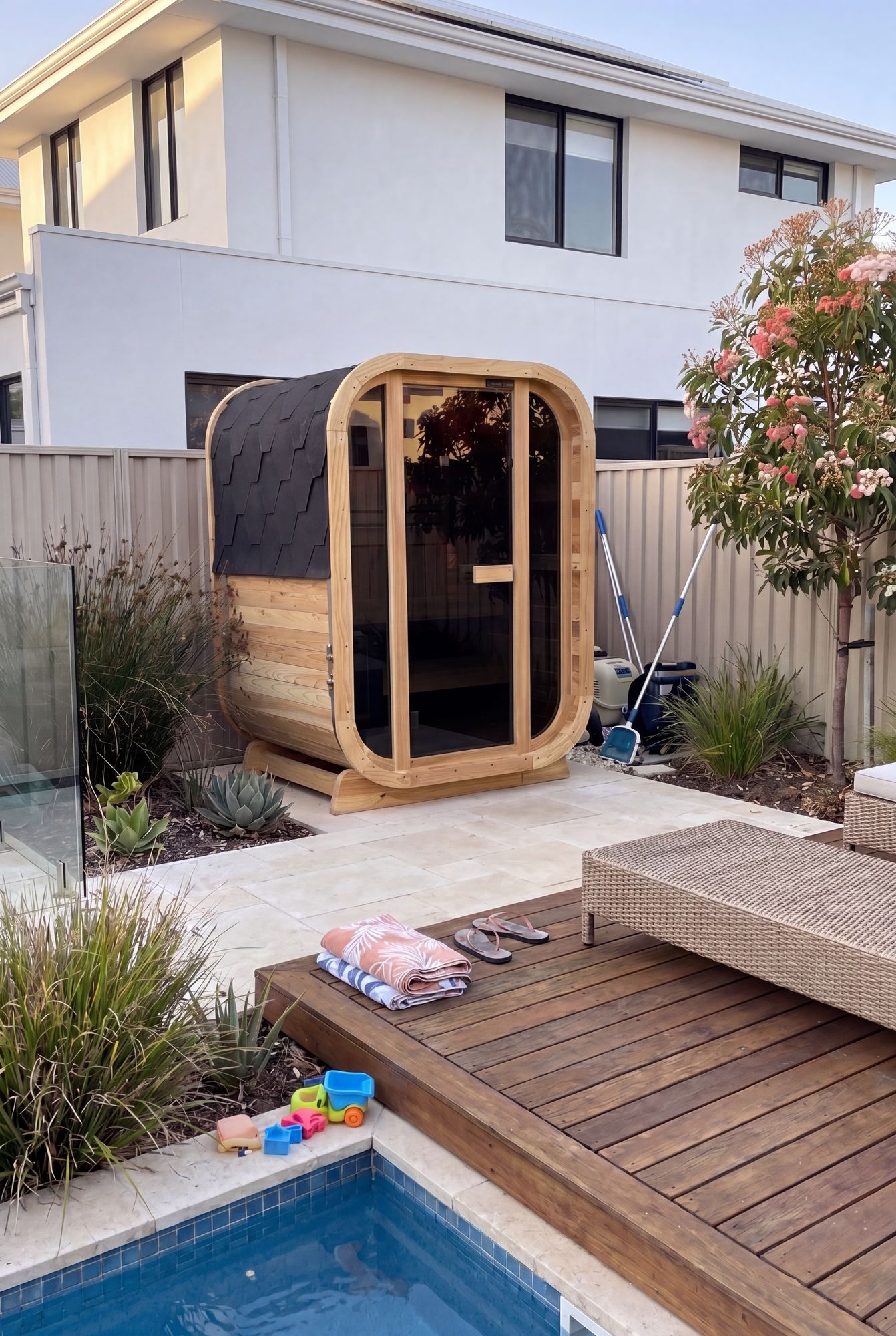
The sauna remains a normal electrical load
Solar panels generate DC electricity; the inverter converts it to the AC electricity used by household appliances.[1] The sauna still needs the supply, protection and connection specified for its heater and controls. It is not connected straight to a spare roof panel. Have a licensed electrician assess the sauna circuit and discuss system integration with the solar installer. A solar system does not remove the need to check switchboard capacity, cable routing or the exact heater installation instructions.
Look at available power, not the panel headline
Panel capacity, inverter output and surplus generation are different things. Other appliances may already be using much of the power produced. Check your monitoring data at the time you would like to preheat the sauna, including the effect of clouds and household activity. The Australian Government recommends matching appliance use with generation and using monitoring to understand the system.[2] A sunny-day export reading is a useful clue, but it is not a guarantee that the same surplus will persist through the whole heating window.
Use a clear financial example
Suppose a heating window uses 6kWh: a 6kW heater runs for 45 minutes at full power and another 30 minutes at an assumed 50% duty. Suppose monitoring shows 4kWh supplied by otherwise exportable solar at the same times the heater needs it, after other household loads, and 2kWh imported. At an illustrative import tariff of AUD $0.35/kWh and foregone feed-in tariff of $0.05/kWh, imports cost $0.70 and lost export credit is $0.20. The combined incremental energy cost is $0.90, compared with $2.10 for 6kWh entirely imported at that rate. These are hypothetical calculations, not measured performance, live electricity prices or bathing-duration advice. This example does not size a solar or battery system: 6kW of panels does not guarantee continuous 6kW supply.
Count the export trade-off honestly
Government guidance explains that self-consumption avoids purchasing electricity but can also reduce export credits; feed-in tariffs are typically lower than import rates.[3] Your actual plan decides the comparison. If generation would otherwise have been curtailed, the export opportunity may differ. Do not automatically assign the same saving to every solar kilowatt-hour. Demand charges and time-of-use rates can also matter, especially if the sauna overlaps with cooking, vehicle charging or other substantial loads.[2][3]
A battery needs both energy and power capacity
A battery can shift solar energy into an evening routine, but stored kWh alone does not establish whether it can support the heater load. Ask the installer about usable capacity, continuous output, other loads and backup-circuit arrangements. Government guidance notes that backup availability depends on the battery and inverter setup, including which circuits are supplied.[1] Do not assume the sauna will work during a blackout. Battery purchase cost also belongs in the assessment; a lower session import figure does not by itself establish a worthwhile battery investment.[3]
Schedule around safe use, not generation alone
A daytime routine may make better use of the roof than an evening one, but only if it suits the household. Complete the required heater-area checks before starting, including for approved remote controls. Do not improvise a smart-plug solution for a hardwired heater or bypass the controller to follow solar output. Start with real monitoring, an electrician-approved installation and a realistic routine. The goal is lower grid dependence where practical, not a claim that solar makes every session free.
Your practical checklist
- Compare available surplus with the heater load throughout warm-up.
- Check import rates and the export credit you give up.
- Confirm battery output and backup circuits with the installer.
- Keep all manufacturer pre-start and remote-operation safeguards.
Find your outdoor Cube

Swell Cedar Cube 2
A compact option for one or two people. Compare the current dimensions and heater packages.
Explore Cube 2
Swell Cedar Cube 4
Room for up to four people. Check the bench layout against the way you want to use it.
Explore Cube 4Keep reading
Sources and further reading
- Inverters | energy.gov.au
- Get the most from your solar system | energy.gov.au
- How solar pays for itself and batteries reduce bills
General buying guidance, not a substitute for the supplied installation instructions or individual professional advice.


